Wednesday, 25 January 2012

Update no. 2: Impressions of Niger in January 2012


This picture was made on January 19, 2012 in the Adouna valley (Tahoua Region, Niger). The valley is about 40 km long and has a Faidherbia albida dominated parkland on about 40,000 ha. In some places the parkland is very dense and it has a good mixture of trees in all age classes. The crop residues shows that all the land between the trees is cultivated. Groundwater in this valley is fairly low and soils are quite fertile. This partially explains why this parkland is in such a good shape. Several long low dams have been built across the valley floor, which force runoff to infiltrate. Higher groundwater levels have allowed the expansion of irrigation. If the irrigated area is 1500 ha and the average yield of onions is 20 ton/ha, then this valley alone already produces 30,000 tons of vegetables.


One of the first major events in 2012 would have been a study visit by a delegation from Nigeria to Southern Niger. This delegation would draw lessons from re-greening in Southern Niger for agroforestry policy and practice in Nigeria. The Heinrich Böll Foundation in Abuja had composed an extraordinary delegation of about 30 participants representing policymakers from all 12 states bordering Niger, researchers, NGOs, staff of the Federal Ministry of Agriculture. Unfortunately the visit had to be postponed at the last minute due to the general strike in Niger, which led to the closure of banks, gas stations and the border between Nigeria and Niger. Together, we will start looking for a new date.


The visit was postponed just upon our arrival in Niger, so it was decided to anyway make a field visit to the Dosso, Maradi, Zinder and Tahoua Regions.


Let me share with you some pictures and impressions.
The purpose of the visit to the area around Dogon Kiria (Dosso region) was to look at re-greening activities just started in this “commune” under a project managed by Both Ends and funded by the Netherlands-based Turing Foundation. A major indicator of farmer-managed re-greening is that suddenly one can see everywhere in the fields young trees that have been pruned. The area where this is happening has about 350 mm rainfall and is at the edge of where cultivation is possible. The young pruned trees show that the process has begun.


A visit to parts of the Maradi and Zinder regions is always a source of inspiration. It is where farmers have built new agroforestry parklands on 5 million ha. Let me tell you about some new impressions.


Inter-village institution building for land rehabilitation and re-greening
Not far from the small town of Illéla (Maradi Region) water harvesting techniques (half moons) are used to successfully rehabilitate barren degraded land. This is not new in itself, but what is new is that this is done jointly by a number of villages and they have set rules for the protection and management of the trees planted in the half moons and those that emerged spontaneously (see picture 2). Villagers use bicycles to police the rehabilitated area and they have developed sanctions for those who don’t respect the rules. This activity was initiated by the IFAD-funded PPILDA project. It would be very useful to analyze and document this experience as it is one of the few examples of successful inter-village institution building for land rehabilitation and re-greening.


Introducing farmer-managed re-greening in primary schools

As Abasse Tougiani explained, it is important to involve school children in re-greening and the children of the school shown in picture 3 know about the role of trees in reversing land degradation and they have been trained to prune trees. These kids will soon receive a delegation of school children from another village and they will inform and train them in re-greening. This was the first time that I’ve seen farmer-managed re-greening introduced into the curriculum of a primary school. Looking at the enthusiasm of the children, it is obvious they have become champions.


Barren degraded land rehabilitated collectively by a group of villages in the Illéla department.


Large-scale regeneration of baobabs in the Mirriah department (Zinder Region)
Although Southern Zinder is dominated by young agroforestry parkland, there are also significant areas where other trees dominate. Around the small town of Mirriah one finds vast areas with baobabs in all age classes. Picture 4 shows a dense stand of fairly old trees, which produce valuable leaves and fruit. The owners of the trees often sell the leaves on the tree to young men, who harvest them, put them in bags and sell the leaves in regional markets. It is said that baobabs in the Sahel barely regenerate, but they do so at significant scale in the Mirriah department, but also in the Yatenga region of Burkina Faso.


School children have become champions of re-greening


An impressive stand of baobabs close to Mirriah


New agroforestry parklands and locally rising groundwater levels in the village of Batodi (Tahoua Region)
After having travelled through the 42 km long Adouna valley, we decided to make a quick visit to the village of Batodi, which I had visited several times between 1989 and 1994, then again in 2004 and for the last time in 2006. In 1990 this village was surrounded by a vast expanse of barren degraded land and with the support of an IFAD-funded soil and water conservation project villagers had timidly begun to rehabilitate barren degraded land using “zaï”. Sitting down with villagers in 1991, I joked:
“ can I buy some degraded land to rehabilitate it with zaï”. Their reaction was…”no you can’t ..if someone sells land we’ll buy it ourselves”. This I how I coincidentally stumbled across the fact that a land market had emerged and that people were buying and selling degraded land using simple water harvesting techniques to rehabilitate it.


When I got back to Batodi in November 2004 after not having visited the village for a decade, the first thing they said was…” the water level in our wells is now only at 4 m depth, and it was at about - 18 m when you were here last time”. The higher level of water in the wells allowed women start a vegetable garden. As 2004 was a drought year (less than 200 mm rainfall in this area), the vegetable garden was vital to women. They sold the vegetables on the market and their families consumed what they could not sell. The number of vegetable gardens in this village had increased from 2 in 2004 to 10 in 2012. Picture 5 shows one of these vegetable gardens.


Onion is the most popular vegetable grown in the village of Batodi, like in many other places in Niger.


The question arises as to how this increase in groundwater levels can be explained? We looked at two wells at the end of the day and water was at 4 – 6 m deep and it is apparently at about 3 – 4 m early in the morning before they begin irrigating. Is it increased rainfall? Interestingly, 2004 was a drought year and so was 2011. This makes it unlikely that increased rainfall has caused local groundwater level to rise. If increased rainfall would be the major causal factor, then also other villages would experience a rise in groundwater levels and that is not the case. A much more likely explanation is that the systematic rehabilitation of degraded land using water harvesting techniques, which forces rainfall and runoff to infiltrate has led to a local recharge of groundwater.


The agroforestry parkland in Batodi is young and in parts dominated by Piliostigma reticulatum, which provides fodder for livestock. The picture shows a field that was completely barren 20 years ago. The densities are variable, for instance, tree densities in the background are much higher.. Farmers made it clear to us… higher densities are good for the crops.


Agroforestry parkland and food security
2012 will be a very difficult year in various parts of the Sahel. The food deficit of Niger is estimated to be more than 500,000 tons. Within a few weeks, the results of a study will be available, which explores the relationship between farmer-managed natural regeneration in Southern Zinder and household food security. If all goes according to plan, the next ARI update will report the major findings of this study.
The next ARI update will be written as soon as the results of the above-mentioned study will be available.


You can find more information about ARI and related projects on the Web Alliance for Re-greening in Africa.

Thursday, 12 January 2012

HIGHLIGHTS OF 2011 AND PERSPECTIVES FOR 2012 - ARI update 1


The Badaguichiri valley in Niger was in the 1980s and 1990s scarred by a big gully,
which rapidly drained most rainfall and runoff. Since the building of long and low dams across the valley floor and the introduction of simple water harvesting techniques on the surrounding plateaus, the situation has improved significantly. This picture shows a well developed agroforestry landscape. The faidherbida albida trees look greyish as they don’t have leaves in the rainy season. Sorghum and millet benefit from the nitrogen fixation by faidherbida albida.


HIGHLIGHTS OF 2011: A SELECTION

1. African Re-greening Initiatives (ARI) wants to build on and expand the scale of existing successes in farmer-managed re-greening in drylands. The message that the protection and management of trees and bushes, which emerge spontaneously, is a low cost and efficient form of agricultural intensification, is increasingly getting across.

2. A visit to the Seno Plains in Mali confirmed that farmers protect and manage trees which emerge on their farms. They do so at a large scale and most trees are young. Gray Tappan of the US Geological Survey was asked to look into the scale of these new agroforestry parklands. His analysis of high resolution satellite images revealed medium to high on-farm tree densities on 450,000 ha, which is much more than anyone imagined. Until Gray Tappan established the scale, it was assumed that about 18,000 ha had been re-greened.


The young agroforestry parkland on Mali’s Seno Plains. This picture was taken end March 2011, which is way into the dry season. Nevertheless, vast quantities of crop residues were still stored on the fields.

3. The re-greening partners in Burkina Faso (Reseau MARP and its partners) and in Mali (SahelECO) and its partners are building a movement around farmer-managed re-greening and they undertake a wide range of activities, including the organisation of farmer-to-farmer visits, visits for national and regional policymakers as well as technicians. They get documentaries on national TV, but also show these in village meetings. They organize groups that discuss agroforestry policy and legislation.

4. The International Fund for Agricultural Development (IFAD) approved a two year grant for “Supporting Farmer-Managed Natural Regeneration in the Sahel”. This will allow us to develop a national policy dialogue around farmer-managed re-greening in Senegal, Mali, Burkina Faso and Niger. Besides the policy dialogue, two more activities are included under this grant. The first is a study on the socioeconomic impacts of agroforestry systems in the Sahel, which is implemented by the World Agroforestry Centre (ICRAF). The second is the production of 12 mini-documentaries about successful adaptation to climate change in Afrca’s drylands. These documentaries will be ready by mid-2012.

5. In November a start was made with the formulation of a national re-greening strategy and action plan for Niger. This process will be finalized early in 2012. This activity is funded under the IFAD project mentioned under 4.


Southern Zinder (Niger) has many small depressions surrounded by sandy dunes (wetlands in drylands). Farmers grow a large variety of crops and trees in these depressions, which include sugar cane, rice, date palms, vegetables, fruit trees (papaya and mango). On the surrounding sand dunes, the number of Faidherbia albida is increasing.


6. The Web Alliance for Re-greening in the Sahel (www.W4RA.org) is increasingly operational. In November, the first version of a newly developed voice-based Radio Marché system was tested in Mali. Radio Marché will be used by SahelEco and by two community radio stations in Segou and Tominian.Radio Marché has been developed in close collaboration with the end-users, who actively contribute in its development. It is based on mobile voice and web technologies. It has been designed to automatically generate voice communiqués of market information, which can be broadcasted on the radio.

7. More good news from the web alliance. In November the W4RA was informed that it had won the International Press Institute contest. The proposal, to deploy innovative voice services for the empowerment of radio journalists in Mali, who work for community radio stations promoting Re-greening Initiatives in the Sahel, has been selected amongst 376 proposals. From the 376 proposals submitted, only 3 received a grant. The project will run during 12 months, starting in 2012.

8. In September, Chris Reij visited Nairobi to explore the possibilities for a re-greening initiative in Kenya and to build stronger links with the World Agroforestry Centre (see ARI update 2011 no.6). There’s an exceptional opportunity for promoting farmer-managed re-greening in Kenya as it is the only country in Africa, which has included I its constitution that all farmers should have 10% of their land under trees. Protecting and managing spontaneous regeneration on-farm and off-farm is an interesting option for Kenya’s drylands.

9. The working links with the World Agroforestry Centre (ICRAF) are increasingly stronger. Invaluable support was provided during the September visit to Nairobi and close contacts are maintained with Dennis Garrity, until recently DG of ICRAF and the driving force behind its Evergreen Agriculture Initiative.

10. Tony Rinaudo of World Vision Australia is another driving force behind re-greening. In June Tony Rinaudo, Gray Tappan and Chris Reij visited the Kaffrine area in Senegal where World Vision Senegal is promoting farmer-managed re-greening. Several farmers from the Kaffrine area visited Niger 4 years ago and upon return they began protecting and managing spontaneous regeneration. Re-greening now takes place on about 40,000 ha and intensification in existing areas and expansion to others is certain.

11. In 2011, Tony Rinaudo also successfully trained farmers in such diverse countries as (Northern) Ghana, Tigray (Ethiopia), East Timor and East Sumba (Indonesia). In Tigray the regional government is now institutionalizing farmer-managed re-greening. Tony will be asked to produce a next ARI update as soon as he has time in his busy schedule. The message is spreading to other parts of the world.

12. In September, Chris Reij made a presentation at the World Resources Institute in Washington (www.wri.org) World Resources Institute (WRI) is one of the driving forces behind a new Global Partnership for Forest Landscape Restoration. This partnership wants to restore 150 million ha of degraded forests till 2020. That’s a bold target, which requires bold action. A link will be built between this partnership and African Re-greening Initiatives.

13. The documentary “ The man who stopped the desert” made by Mark Dodd about the life, innovations and impact of Yacouba Sawadogo, farmer innovator in Burkina Faso, won 7 awards in 2011 (www.1080films.co.uk). On December 12, Yacouba received a national decoration (Chevalier de l’Ordre de Mérite Nationale).

14. LucGnacadja, the Executive Secretary of the UN Convention to Combat Desertification, invited Yacouba Sawadogo and Mathieu Ouedraogo to join a special day at the Caux Forum on Human Security in Switzerland, which was dedicated to discussing the restoration of the Earth’s degraded lands (www.cauxforum.net). About 250 participants from 50 countries watched the documentary, which triggered many positive reactions.

15. Yacouba Sawadogo hit the spotlight in 2011 as he was also invited to speak in October at a special session of the Conference of Parties of the UN Convention to Combat Desertification held in Changwon (South Korea). During the opening session of this Conference of Parties, UN Secretary General Ban Ki moon specifically mentioned Yacouba and his work.

16. The media continued to pay attention to farmer managed re-greening. Articles were published, amongst others, in: The New Yorker (Dec. 19&26), Le Monde Diplomatique (November), The Nation (November) Our Planet, which is UNEP’s flagship publication (September), Ökotest (December) as well as a special issue Environment and Energy published in August, Bild der Wissenschaft (August), Welt am Sonntag (March 27), Suddeutsche Zeitung (October 31) and Daily Telegraph (July 15). This media exposure acts as counterweight against the usual doom and gloom stories published about drylands.

17. The re-greening movement is building and the number of champions is increasing. Just to give some examples. In September, Roland Bunch (www.rolandbunch.com), who authored the famous book “Two Ears of Corn: a guide to people-centered agricultural improvement” mentioned his support for re-greening and a willingness to get involved. In the same month Groundswell in Ghana (www.groundswellinternational.org) expressed its interest in developing re-greening in Northern Ghana and they will mobilize their own funding.


Perspectives for 2012

1. Key in 2012 will be…let’s catalyze more on the ground action…and let’s develop dialogues with national and international policymakers around re-greening. The financial support by FINHUMF and the IFAD grant for 4 countries in the Sahel will help us to continue pushing forward.

2. A national re-greening workshop will be organized in Ethiopia early in 2012 about re-greening successes in this country. The Government of Ethiopia intends to reforest 15 million hectares and to plant 100 million fertilizer trees (Faidherbia albida). The objective of the workshop will be to try to feed some lessons into national policy and practice. The workshop will be co-organized by the Horn of Africa Regional Environment Centre, FAO and FarmAfrica.

3. A regional workshop on re-greening will be organized by World Vision early April in Nairobi. Tony Rinaudo will spend 3 months in this region to visit partner and provide training.

4. The national re-greening strategy and action plan for Niger will be assessed in a national workshop early this year. There is no reason why this national strategy should not become operational in 2012.

5. Closer links will be forged not only with World Resources Institute and the Global Partnership for Forest Landscape Restoration, which I now tend to call more simply…Global Re-greening Initiative, but also with Evergreen Agriculture, World Vision Australia and with other re-greening initiatives.

Finally I would like to thank all of you who have directly or indirectly provided support to re-greening under ARI. I wish you a healthy and inspirational 2012. Let’s together try to make the world a bit greener to improve food security, adapt to climate change, reduce rural poverty, alleviate the burden of women and girls have who collect firewood, increase the fodder available to livestock, maintain or improve soil fertility, increase biodiversity, restore ecosystem services. Resource users can do it themselves, but sometimes they need a bit of external support…not necessarily money, but new ideas and new experience. There is no other intervention that produces so many benefits at such low costs. Let us catalyze more action. Your involvement in this process is vital.

Chris Reij
January 6, 2012

Thursday, 20 October 2011

News from the United Nations Conference to Combat Desertification in South Korea

Looking to the Sahel for Lessons in Pushing Back Deserts

Article by Stephen Leahy


CHANGWON, South Korea, Oct 17, 2011 (IPS) - Nearly all our food comes from the Earth's limited food- producing lands, but those lands continue to be degraded, guaranteeing far higher food prices and less food in the future, experts warn.

But degradation and desertification can be halted and reversed, as evidenced by once barren parts of Africa's dry Sahel Region that are now green and thriving thanks to local efforts.


read more

Friday, 7 October 2011

ARI update 7: October 2011


Wangari Maathai (April 1, 1940 – September 25, 2011)


Wangari Maathai
From September 5 – 16 I was in Nairobi to meet with the World Agroforestry Centre (ICRAF), the Green Belt Movement and many other organisations. Almost everyday I travelled to and from my hotel to ICRAF…and every time I looked at a piece of beautiful and diverse forest in the city. The driver explained that it is the Karura Forest and he said..”it’s still there because of Wangari Maathai…in the 1990s the forest was given to developers who wanted to build big houses, but Wangari Maathai resisted this development”. On my way to the Kenyan Forest Research Institute, a driver made a similar remark about another forest.


Later I understood that resisting the developers meant that she was beaten up badly and even had to be hospitalized, but as soon as she got out of the hospital, the first thing she did was to go back to the forest to continue action….that’s courage…and she, and those who supported her,…won the battle.


She will always be remembered because she created the famous Greenbelt Movement, which planted tens of millions of trees in Kenya’s Highlands and she won the Nobel Peace Prize in 2004, because of her relentless work not only for the environment, but also for democracy, peace, women’s rights and empowerment of the poor.


On September 23 I had the privilege to be in a meeting with Prof. Karanja Njoroge, the Executive Director of the Green Belt Movement, during which he unveiled a plan for creating a Wangari Maathai Institute for Peace and Environmental Studies at the University of Nairobi. I assume that funding will be mobilized to create this institute in memory of Wangari Maathai. One thing is certain…with or without this institute, she will continue to live in the hearts and minds of many people in and outside Africa for who she was, for what she did and for the difference she made.


Exploring a re-greening initiative in Kenya

Many parts of Kenya’s highlands have high on-farm tree densities and Grevillea robusta is a common species. Kenya is the only country in the world that has a Constitution which requires farmers to have 10% of their land under trees. Kenya has its successful Green Belt Movement…so why go to Kenya to explore a re-greening initiative?


The answer to this question is that almost all re-greening in Kenya is concentrated on planting of trees in the Highlands of Kenya and much less on Kenya’s drylands (about 80% of the country). Very little attention is paid to the potential of promoting on-farm and off-farm re-greening through the protection and management of natural regeneration.


This visit could not have come at a better moment as the Ministries of Agriculture and of Environment have started reflections about how to implement the 10% rule.

Dennis Garrity, DG of ICRAF till September 16, and his staff, provided all possible support to make this visit a success. Without their support much less would have been achieved. Meetings were held amongst others with:

- Prof. Margaret Kamar (Minister of Higher Education, Science and Technology)
- Dr. Linah Jebii kilimo (Assistant Minister for Co-operative Development and Marketing)
- Dr. Wilson A. Songa (Agriculture Secretary, Ministry of Agriculture)
- Eng. J.A. M. Nkanya (Agricultural Engineering Service, Ministry of Agriculture)
- Mr. Wafula Mutoro (Head of Soil Conservation and Fertility Branch, Min. of Agriculture)
- Mrs. Janet A. Oyuke (Head Agroforestry, Ministry of Agriculture)
- Dr. Ben Chikamai (Director Kenya Forestry Research Insititute)
- Dr. Phanuel Oballa (Asst. Director Kenya Forest Research Institute)
- Prof. Karanja Njoroge (Executive Director Green Belt Movement)
- Mr. Mounkaila Goumandakoye (Director Africa UNEP)
- Dr. Mahamane Larwanou (African Forest Forum)
- Dr. Bashir Jama (Director Soil Health Program, AGRA)
- Mr. Lawrence Kiguro (Associate Director World Vision Kenya)
- Mr. Henrik Brudin (Regional Director SCC-Vi Eastern Africa)
- Mr. George Onyango (Deputy Regional Director SCC- Vi Eastern Africa)


All showed a keen interest in natural regeneration to build new agroforestry systems and to restore degraded natural forests. The impact of this visit is probably that farmer-managed natural regeneration will be on the table as an option for Kenya’s Arid and Semi-Arid Lands.


The next step will be a regional meeting in Kenya on re-greening, which will be organized by World Vision. Tony Rinaudo of World Vision Australia plans to be in the region from March – May 2012. His visit will include practical training in farmer-managed natural regeneration. All persons met during this visit in first half of September will receive the ARI updates and will be informed about the regional conference in March 2012.


In the week of September 12 – 16, ICRAF had its Science Week, which meant that most ICRAF researchers were in Nairobi. This provided an extraordinary opportunity for discussion with researchers in-between meetings in town. It was possible to meet regularly with Dennis Garrity, who after having done two terms as DG of ICRAF will now become responsible for ICRAF’s Evergreen Agriculture Initiative, Phil Dobie (policy advisor), Moctar Touré (senior fellow), Ermias Betemariam (landscape ecologist), and many others.


The re-greening movement is expanding
Met in Nairobi with Roland Bunch, the author of “Two Ears of Corn” (www.rolandbunch.com). Roland worked for many years on cover crops in central America and is now very worried about declining soil fertility in many parts of Africa. Roland recently visited the on-farm re-greening in Mali’s Seno Plains and wants to join the ARI movement, which is very good news, because he brings with him vast experience and a big network.


At the same time a message arrived from CIKOD-Groundswell in Northern Ghana (www.groundswellinternational.org) with the request…can we join the re-greening movement? We want to promote re-greening in Northern Ghana and will try to mobilize our own funding. My reaction…yes, of course…you make my day. More about this in the next update.


Networking about farmer-managed re-greening in Washington (September 20 – 23).

Presentation at the World Resources Institute on September 21 about “Expanding re-greening successes in Africa’s drylands to increase food security and reduce poverty”


Multiple meetings at World Resources Institute with Bob Winterbottom (Director Ecosystem Services), Edward Cameron (Director International Climate Initiative), Nigel Sizer (Director Global Forest Initiative), Lars Laestadius (Senior Associate) and Manish Bapna (Interim President).


Presentation at World Bank TerrAfrica of “The man who stopped the desert” followed by discussion. About 30 persons attended, including Mary Barton-Dock, Director Environment, Martin Bwalya, Head of the Comprehensive African Agriculture Development Program (CAADP) of the New Partnership for Africa’s Development (NEPAD) and Paola Agostini of TerrAfrica and Regional GEF coordinaotor. The documentary was followed by a lively exchange about the role of farmer innovation and about farmer-managed re-greening.


Mary Barton-Dock subsequently stated the following:


This film is a wonderful piece of storytelling that recounts many critical lessons in the pursuit of economic and environmental sustainability in the Sahel. Yacouba's thriving farm and forest -- and the land rehabilitated by others he inspired -- show that individual champions and local communities can achieve much. But the film also shows that these remarkable achievements need to be underpinned by a strong policy and institutional environment, such as enforceable local resource rights and government accountability.


A follow-up presentation/meeting will be scheduled early in 2012.


Presentation at US Agency for International Development about “How can USAID help feed the future”. This presentation, which was organized by natural resource management specialists Chris Kosnik and Mike McGahuey, was also attended by 3 staff of the Food Security Bureau. It was followed by a meeting with Christian Holmes, USAID’s Global Water Coordinator, who suggested at the end of the meeting that he would like to visit the farmer-managed re-greening /new agroforestry parklands in the Sahel and he felt that was presented should be brought to the attention of the USAID Administrator.


A meeting at the Global Environment Facility with senior environmental specialist Mohamed Bakarr to discuss where re-greening/agroforestry can be presented in the upcoming Conference of Parties of the UN Convention to Combat Desertification in October in South Korea.


During the different presentations in Washington, it was emphasized that resource users protect and manage natural regeneration for many reasons. One is that it helps them build more productive and more drought resilient farming systems. To farmers it is the lowest cost way of intensifying agriculture. One of the main benefits to women is that it reduces the time required for collection of firewood as they can now prune on-farm trees rather than walk many miles to search for some shrubs.


“The man who stopped the desert”


Since the beginning of 2011 this documentary about the life, innovations and impacts of farmer innovator Yacouba Sawadogo has won 4 awards:

February 2011 Special Jury Award at International Forest Film Festival (USA)
May 2011 8th Award at International Audiovisual Festival of Biodiversity (Rome)
August 2011 Best sustainability message at 10th Japan Wildlife Film Festival
September 2011 Sapphire award Montana Cine International Film Festival
and in April/May the film has been shown 4 times at France 5.


Mark Dodd (www.1080films.co.uk), who made the documentary, is now developing a scenario for a more general documentary about the multiple impacts of re-greening/agroforestry.


Web Alliance for Re-greening Africa (W4RA)


The 4 minute clip below explains the tools that the Web Alliance for Re-greening Africa is now developing to increase access of resource users to relevant information about re-greening and its impacts. It is essentially about linking mobile phones and rural radios. The tool has already been tested in Mali and a wider roll out will be tried in Mali in November. If it works then it can be used at a much larger scale to spread info about farmer-managed natural regeneration as well as on the natural regeneration of degraded forests.


W4RA film

Given the ambitious re-greening/forest landscape restoration initiatives now emerging, the strategic importance of this work by the Network Institute of VU University Amsterdam and the Web Foundation of Sir Tim Berners-Lee is increasing.


Media attention for re-greening


An article in the September issue of UNEP’s flagship publication….One Planet. This issue of One Planet was published just before a special session on September 20 of the UN General Assembly about desertification.


The German science magazine “Bild der Wissenschaft” published an article in its August issue.


It should also be mentioned here that all African Ministers of Agriculture met in South Africa in the week of September 12….about Climate Smart Agriculture. The document specifically prepared for this meeting contains a case study about re-greening in Niger and its cover page shows a Faidherbia albida parkland in Tanzania with a beautiful stand of crops under the trees. The message is increasingly getting across that agroforestry is a vital pillar in improving food security, increasing drought resilience of production systems and reducing rural poverty.


Tony Rinaudo of World Vision Australia and his partners


Tony is relentlessly promoting farmer managed natural regeneration and he is organizing training workshops from Ethiopia to Ghana and from Sumba (Indonesia) and East Timor to Senegal. More attention will be paid to his work in the next updates. Below some pictures of a training workshop in Tigray (Ethiopia) earlier this year, which included practical as well as theoretical training.

Thursday, 28 July 2011

Advocacy and networking on regreening


On the right Luc Gnacadja, Executive Secretary of the UN Convention to Combat Desertification and on the left Yacouba Sawadogo, farmer innovator from Burkina Faso, who is the key person in the documentary “The man who stopped the desert”. They met in Caux (Switzerland) on July 15 during a full day special event on “restoring Earth’s degraded land reversing man-made deserts, reviving agricultural land”


Special event at the 4th Caux Forum on Human Security in Switzerland.
On July 15 about 250 participants from 50 countries attended a full day special event during the Caux Forum on Human Security in Switzerland. Clare Short, former UK Secretary of State for International Cooperation introduced the day and Luc Gnacadja, Executive Secretary of the UN Convention to Combat Desertification made a challenging presentation about reversing man-made deserts using as title: “Soil, so much depends on so little”. The presentation can be found at www.unccd.int under a section about the Caux Forum.

Since 1980 Yacouba Sawadogo improved traditional planting pits or zaï, a technique that has since then been used to rehabilitate tens of thousands of hectares of strongly degraded land in the Sahel. He is the key person in the multiple award winning documentary “The man who stopped the desert”. The French and the English version of this documentary were shown simultaneously and deeply impressed and moved all participants.


The question and answer session at the Caux Forum after the documentary was shown. On the left Yacouba Sawadogo and on the right Mathieu Ouedraogo, coordinator of the re-greening initiative in Burkina Faso.


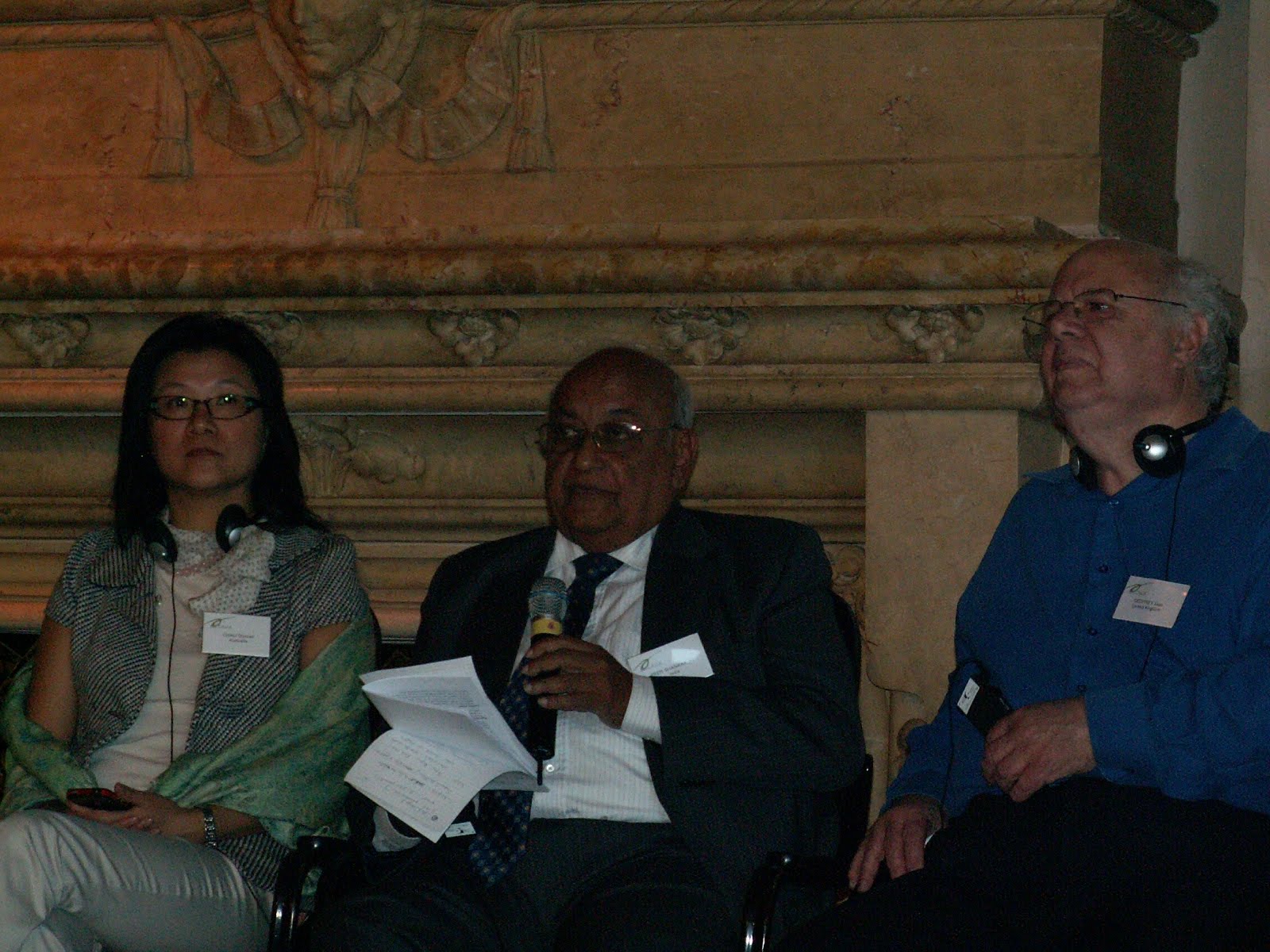
Among the participants were not only farmers, development specialists, human rights lawyers and activists, energy specialists, documentary makers, diplomats and politicians, but also two distinguished journalists: Mr. Prem Shankar Jha from India and Mr. Geoffrey Lean from the United Kingdom. Mr. Jha is a prolific author and continues to publish frequently in the Hindustan Times and other journals. Mr. Geoffrey Lean is the UK’s most senior environmental journalist. During the Caux Forum he produced an article, which was published in the business section of the Daily Telegraph on Saturday 16 July entitled: “The earth can’t afford to lose any more ground”. This article mentions re-greening in Niger.


On the left Mrs. Chau Duncan, Australia’s Trade Commissioner for Clean Energy and Environment. In the middle Mr. Prem Shankar Jha and on the right Mr. Geoffrey Lean.


During an informal meeting of a small group of environmental specialists, Mr. Jha described how millions of hectares of degraded areas in India still have underground root systems which offer possibilities for natural regeneration. His analysis showed striking similarities with the analysis by Tony Rinaudo of World Vision Australia for parts of Niger where underground root systems were an important source of re-greening.


Participation in this special event generated many new contacts as well as invitations to expand ARI to Tchad, Rwanda, Uganda and other countries. As a starter all new contacts will receive the ARI updates.


Advocacy in Mali
From 19 – 22 June, a small delegation of representatives of the Ministry of Agriculture, farmer organisations and NGOs, led by the Vice President of the “Haut Conseil des Collectivités Locales” visited six field sites to get first hand information from farmers about their experience with the protection and management of natural regeneration. They were impressed by the transformation that has occurred and by the multiple impacts generated by the increasing number of on-farm trees. The delegation was accompanied by radio, TV and press.


The Vice-President of Mali’s « Haut Conseil des Collectivités Locales « presents a gift to Mr. Zié Diakité, a farmer from the village of Diénina, who distinguished himself in the 2010 agroforestry competition. On the right, Mr. Mamadou Diakite of SahelECO and in the middle (with camera) Mr. Mamadou Lamine Coulibaly of the national coordinating body of Mali’s farmer organisations (CNOP)


Ethiopia
Interesting news from Ethiopia is that Prime Minister Meles Zenawi seems to have stated recently that the re-greening of Ethiopia will form one of the three key pillars for Ethiopia to achieve a Green Economy. PM Meles Zenawi represented Africa during the Climate Change Conference in Copenhagen in December 2009. It is highly significant that he specifically mentions re-greening as a key pillar. We hope to provide more details in one of the next updates.


Building drought resilient production systems in the Horn of Africa: a key challenge

All media are now reporting on an almost daily basis about the drought and famine in Somalia and parts of Ethiopia, Kenya and Uganda. The articles highlight human suffering on an increasing scale. The costs of food aid are estimated to be more than one billion euro. Slowly but surely awareness is emerging that it may cost less to develop more drought resilient production systems at scale than to cope with famine and its impacts.


The Government of Kenya is taking steps to implement a policy that requires all farmers in Kenya to grow trees on ten percent of their cultivated land, which may be easier in Kenya’s highlands than in its drylands. A major challenge will be to improve range management to make livestock systems more drought resilient and to reduce conflicts between herders as well as between herders and farmers.


The IFAD-funded project on “Support to Re-greening in the Sahel”
As mentioned in the previous update, the World Agroforestry Centre (ICRAF) organized a workshop in Bamako early June about the methodology of a study on the economics of agroforestry in the Sahel. Filming 12 cases of successes in adaptation to climate change has begun and contracts are established with partners in four Sahel countries: Senegal, Mali, Burkina Faso and Niger, who will be responsible for developing national policy dialogues around re-greening.


Web Alliance for Re-greening Africa (W4RA)
Here you can find a 6 minute clip posted on July 8 on Youtube, which explains the work of the Web Alliance for Re-greening Africa.


Some next steps
1. A visit to Kenya is planned for early September to present the IFAD-funded project “Support to Re-greening in the Sahel” and to explore possibilities for developing a re-greening initiative in Kenya.


2. As soon as possible, but certainly before the end of 2011, a discussion note will be produced about the development of national strategies for re-greening. The target group for this note will be national and international policymakers. It should give them a set of practical steps to quickly expand the scale of re-greening in drylands and sub-humid regions, which will help build more productive and drought-resilient farming systems.


The next update will appear by the end of September … unless there is a reason to share information earlier.

Monday, 27 June 2011

ARI Update 5 June 2011


Farmer-Managed Re-greening in Kaffrine (Senegal) began in 2008


This field is adjacent to the one above; most cultivated land in the Saloum region of Senegal is barren or has low on-farm tree densities (see point 2)


1. World Desertification Day (June 17)
On the occasion of World Desertification Day (June 17), the Secretary General of the United Nations formulated a message, which contained the following paragraph:


“The management, conservation and sustainable development of dry forests are central to combating desertification. The ongoing greening of the Sahel and other success stories around the world show that degraded lands can be reclaimed by agroforestry and other sustainable practices. We need to scale up these interventions and disseminate their results widely”.


This is exactly what African Re-greening Initiatives tries to do and the message of Secretary General Ban Ki-moon encourages all involved to persevere and expand activities.


2. Farmer-managed re-greening in the Kaffrine area (Senegal)
The Kaffrine area is part of Senegal’s Saloum region (Southeast of Dakar), which has low on-farm tree densities. This is the heritage of policies in the 1960s and 1970s to expand mechanized cultivation in Senegal’s peanut basin. The removal of trees and their stumps was subsidized in those days in order to create large treeless fields. In combination with cutting trees for charcoal production, this caused a large-scale degradation of vegetation. World Vision Senegal began doing so in 2008. The number of species protected and managed by farmers is limited. The main species concern Piliostigma reticulatum (for fodder and improvement of soil fertility) and Guiera senegalensis (firewood and fodder).


Every year World Vision Senegal sends a delegation of 22 farmers and staff to Niger to look at and learn from farmer-managed natural regeneration in that country. During the field visit it became quite obvious that farmers who participated in those study visits behave differently. They don’t burn Guiera senegalensis to enrich the soils, but they prune it and use the leaves as mulch, which attracts termites and improves soil structure (see picture below).


The scale of on-farm natural regeneration, which is still in its early stages, now concerns about 30,000 ha, but this includes some areas where densities are still low. However, some key conditions are united for rapid expansion of agroforestry in this region. These include high population densities, sandy soils, low on-farm tree densities and fairly good rainfall (about 700 mm) compared to areas in Niger and Mali where farmer-managed re-greening has already taken place on a large scale (about 500 mm).


The indications are that in 2010, cereal yields were significantly higher on cultivated land with young agroforestry systems than on fields without. This needs to be confirmed by longer-term monitioring.


3. Agroforestry systems in Europe
It can be argued that agroforestry represents the agriculture of the future as it produces “multiple wins”: enhancing food security, adapting to climate change, improving drought resilience, sequestering carbon, increasing biodiversity, etc.


It is interesting to note that agoforestry systems are also found in Europe. For instance in Spain and Portugal millions of hectares are covered by centuries old agroforestry systems, which continue to be maintained. They are largely based on two species of oak, including cork oak, but also on olive trees. Tree densities are often 40 trees per ha or more and under these trees farmers grow cereals or fodder grass. Extensive livestock grazing, which produces high quality meat, is part of this production system. The two photos below show a valley and hills in Spain’s Extremadura region with dense agroforestry and cattle grazing under the trees,where they benefit from fodder and from shade in this warm climate.


4. World Agroforestry Center workshop in Bamako
From June 6 – 8, the World Agroforestry Center (ICRAF) organized a workshop in Bamako about the research methodologies that will be used to study the socioeconomic impacts as well as the costs and benefits of agroforestry systems in the Sahel. This is one of the three components of an IFAD grant to support re-greening in the Sahel. The workshop also identified research partners and made a first selection of potential research sites.


5. First Africa Drylands Week in Dakar
From June 13 – 17, the first Africa Drylands Week was held in Dakar. This Drylands Week (about 150 participants) was organized by a wide range of organizations: FAO,the Great Green Wall, the Earth Institute of Columbia University, etc. Many presentations were made on a wide range of themes relevant to dryland development. One aspect that transpired during the presentations and discussions is that the interest in farmer-managed re-greening and evergreen agriculture is increasing strongly. This is partly due to the fact that conventional tree planting has often produced disappointing results. A next update will provide a link to the report as soon as it becomes available.


6. Preparation of field visit by a delegation from Nigeria to Niger
During the workshop on agroforestry in Niger held in January 2011, the idea emerged to organize a field visit by a delegation from (Northern) Nigeria, which has in quite a few places low on-farm tree densities, to the new dense agroforestry parkland of Southern Niger. The partners in Niger are willing to organize a workshop and a field visit. Dr. Chinwe Ifejika Speranza, a Nigerian climate scientist, is a driving force behind this initiative. She has contacted the Heinrich Böll Stftung in Germany, which is willing to fund the cost of the Nigerian delegation. This workshop is likely to take place at the end of 2011.

Our hope is that it will lead to a re-greening initiative in parts of Northern Nigeria, which is urgent for many reasons.


7. Advocacy
Many opportunities emerged during the last two months to present farmer-managed re-greening in Africa’s drylands and its multiple impacts. These included presentations at the First Africa Drylands Workshop (June 13), at USAID Dakar (June 16) on “how can USAID contribute to feed the future in Africa’s drylands?, at the occasion of a workshop of the Dutch Knowledge Network “ Sustainability, Climate and Energy” (June 23) on Adaptation to Climate Change in Africa’s Drylands: from research to action; at the Sustainable Foods Summit in Amsterdam (June 23) on Sustainable Innovations and Climate Change in Africa’s Drylands.


8. Expansion of African Re-greening Initiatives: how can you contribute?Both in Burkina Faso and in Mali, the re-greening partners are receiving requests to expand their activities to other regions or provinces. At present the partners in Burkina Faso are working in 6 provinces and their plans are to expand to 10 provinces. The partners in Mali receive similar requests for expansion. They just organized a so-called caravane with national decision makers to the large-scale re-greening in the Seno Plains.

The partners in Niger have just organized study visits for farmers in the Dogon Doutchi region to Maradi.

Besides expansion within the existing countries, possibilities to expand ARI to Kenya will be explored. More about this as well as about Niger and Ethiopia in the next update.

9. Web Alliance for Re-greening in Africa (W4RA)
W4RA is developing and testing its tools. Below you’ll find the link to a short trailer about their field visit in January 2011.

http://www.youtube.com/watch?v=gX5nc_Wf6GA

10.Final remark
This update began with a quote from Secretary General Ban Ki-moon and it ends with a quote from a woman farmer in Senegal, which was on June 21 shared by Tony Rinaudo:


Female lead farmer from Kaffrine (Senegal) who went to Niger Thousands of projects have come through here but this SFLEI ( Senegal Food and Livelihood Enhancement Initiative) there is no comparison, if we are the judges. We have nothing but our environment. Since we started working with Farmer Managed Natural Regeneration we have already started seeing the benefits that we have not seen with any other project. The type of benefits we see pushes me sometimes to leave my home and just walk through my field to appreciate the trees and environment. When things get to where they need to be, we will see more yields and the path will be clear.


The next update will be produced around end July.

Monday, 9 May 2011

Update nr. 4


This update begins with a story about the scale of re-greening on Mali’s Seno Plains between the escarpment of the Dogon Plateau and the border with Burkina Faso. This picture shows high tree densities and older trees close to the escarpment. When we look beyond a band with low tree density, a sea of trees can be seen in the distance stretching across the plains. Gray Tappan of USGS-EROS has now uncovered the scale of re-greening.


How did this agroforestry parkland emerge?Just a few remarks and observations:

a. SahelECO and its predecessor SOS Sahel UK have promoted farmer-managed re-greening since the middle of the 1990s.

b. The radio station of Bankass was used to spread the information about the new forestry law of 1995.

c. An increase in rainfall since the middle of the 1990s probably supported the process of regeneration, but as we know from Niger….human management is a more decisive factor in re-greening than rainfall. The process of re-greening in Niger began a decade before the increase in average rainfall and Northern Nigeria has much lower tree densities than Southern Niger despite higher rainfall.


d. Traditional institutions responsible for the management of trees (Barahogon and others) have been successfully revived in this region.

e. SahelECO staff report that about 5% of the trees on the Seno Plains are older than 15 – 20 years and the large bulk of trees is younger.

Source: Gray Tapan USGS-EROS

f. Gray Tappan notes that (1) one finds low densities of on-farm trees on another 175,000 ha; (2) the Seno Plains had high tree densities in the 1960s….they probably dwindled in the 1960s and 1970s and this U curve now shows an upward trend; (3) on the Plateau Dogon itself…interesting examples of high tree densities are found….but this was not part of the analysis.


On the Dogon Plateau one finds cultivated fields with high densities of young Combretum not included in the data for the Seno Plains. It is not only good firewood, but women also gather the leaves and use it as manure in irrigated gardens.

Conclusion: a major agro-environmental transformation has occurred during the last 15 – 20 years on the Seno Plains…its scale was unknown until now….Gray Tappan used high resolution satellite images to uncover the scale…more research needs to be done about the history, evolution and dynamics of this young agroforestry parkland. SahelECO and its partners continue to promote farmer-managed re-greening in this region and elsewhere in Mali. Where a set of conditions are united…it is possible to induce farmers to invest in on-farm trees and transform landscapes and production systems at scale.

There is more good news to report.

International Fund for Agricultural Development (IFAD)
The IFAD project about “support to re-greening in the Sahel” has now been signed by IFAD and by VU University Amsterdam and activities will now be started up (see ARI update 2011 no. ).

World Agroforestry Centre (ICRAF)
Dr. Dennis Garrity, DG of the World Agroforestry Centre, visited Amsterdam on May 1 and 2. Points on the agenda included: closer cooperation between ICRAF’s Evergreen Agriculture Initiative and African Re-greening Initiatives, which s likely to take shape in 2011; building a movement around Evergreen Agriculture and Farmer-Managed Re-greening; joint advocacy and research on impacts of re-greening.

One of the immediate impacts of the visit by Dennis Garrity is that the Centre for World Food Studies of VU University Amsterdam will develop a research proposal on “ the impact of re-greening in Niger on food security” and the department of hydrology will develop a research proposal on “the impact of re-greening on surface and groundwater hydrology”.

Dennis Garrity also mentioned that Evergreen Agriculture rapdly gets a higher profile in India. Prof. M.S. Swaminathan, the highly-respected father of the Green Revolution in India, published a book in 2010 “ From Green to Evergreen Revolution”. This book was officially launched by India’s PM. Under a new Evergreen Agriculture Initiative India plans to plant large numbers of “fertilizer trees”. More about this in future updates. It is quite likely that the protection and management of natural regeneration also has a potential for India.

Ethiopia
The Environmental Protection Agency seems interested in funding a project to protect and expand “church forests” or “belief system forests”, which are centuries old remnants of forests. They show what is called the climax vegetation. These small forests, which have a high biodiversity, risk to disappear due to gradual encroachment by farmers. The amount of funding is not yet known.

Media attention
The Voice of America recently had an excellent story about farmer-managed re-greening, which integrates different messages.


Upcoming events
From 6 – 8 June a workshop will be held in Bamako to discuss the methodology for the ICRAF study about the socioeconomic impact in the Sahel.

From 10 – 16 June, the First African Drylands Week will be held in Dakar. It is a contribution to the International Year of the Forests. One of its objectives is to exploit the knowledge developed in 3 decades of combating desertification and implementing sustainable land management to adapt to climate change and ensure sustainable development.

On April 23, the French TV station France 5 showed a 50 minute french version of the documentary “The man who stopped the desert”. It will be shown again on May 9.